

The wearable sensor red ocean
The wellness wearables market has produced some remarkable companies. Oura, Whoop, Apple Watch, and other category leaders have shown what’s possible when continuous physiological data is paired with strong design, habit formation, consumer trust, and a clean user experience.
If you can build the next Oura or Whoop, more power to you.
For most medical device startups, though, the wearable market has become a red ocean. Investors — rightly so — have grown skeptical of “yet another monitoring device.”
Nearly every physiological signal that mattered five years ago is now available through some combination of consumer devices, medical devices, and hybrid platforms. The incumbents already have distribution, brand recognition, user data, polished software, and massive product ecosystems.
The next frontier for wearables isn’t collecting more signals. It’s using the right signals in combination to deliver meaningful clinical outcomes.
Beyond signals: delivering clinical outcomes
The next-generation wearable medical device isn’t just a sensor. It’s part of a therapeutic system that requires a different proof point:
Can the wearable safely deliver an intervention that improves a meaningful clinical outcome? Can it provide useful data to make that intervention more precise, timely, and personalized?
The demands on a therapy program are different in kind from those placed on monitoring devices. From a design point of view, the burden of proof shifts in several ways:
Accuracy becomes a safety requirement. A monitor can show a noisy reading and let a clinician decide. A therapy system has to make that decision itself, in real time. Signal-to-noise, motion-artifact handling, and the confidence threshold are now safety parameters, not just UX choices.
Reliability becomes uptime. A monitor that drops out for even a minute leaves a gap in the data. A therapy device that drops out leaves a missed or an incorrect dose. Failure modes have to be deterministic, fail-safe, and gracefully recoverable. The engineering bar shifts from “mostly works” in the wellness world to “consistently works, and predictably recovers from potential failures.”
Power becomes a clinical variable. Sensing draws power. On-device computing draws power. Delivering therapy — stimulation, actuation, dosing — draws more. A monitor that runs out of battery is an inconvenience; a therapy that runs out of battery is an interrupted treatment. Battery life sets the practical ceiling on how much therapy can actually be delivered, which means it has to be designed in from the architecture stage rather than retrofitted at the end.
Cybersecurity becomes patient protection. A compromised monitor leaks data or generates false readings. A compromised therapy device can deliver a harmful intervention — or refuse to deliver a necessary one. The attack surface now includes the actuation path, not just the data path, and the consequence model shifts from data breach to bodily harm. Threat modeling, secure firmware updates, and authenticated command channels move from compliance line items to clinical safety controls.
The data has a new customer. Monitoring data flows outward — to a dashboard, a clinician, a report. Therapy data flows back inward, into the device’s own decision-making. That changes how the signal has to be acquired, processed, and trusted from the moment it’s generated by the body.
The strongest moat: the therapy–data loop
The shift in early-stage investor expectations does not mean startups need to do more upfront. In fact, misreading this data often leads teams in the wrong direction.
1. Don’t confuse higher expectations with more functionality
For wearable therapy systems, the real competitive advantage rarely lies in the sensor package or to the therapy mechanism alone. It’s most often the loop they close together.
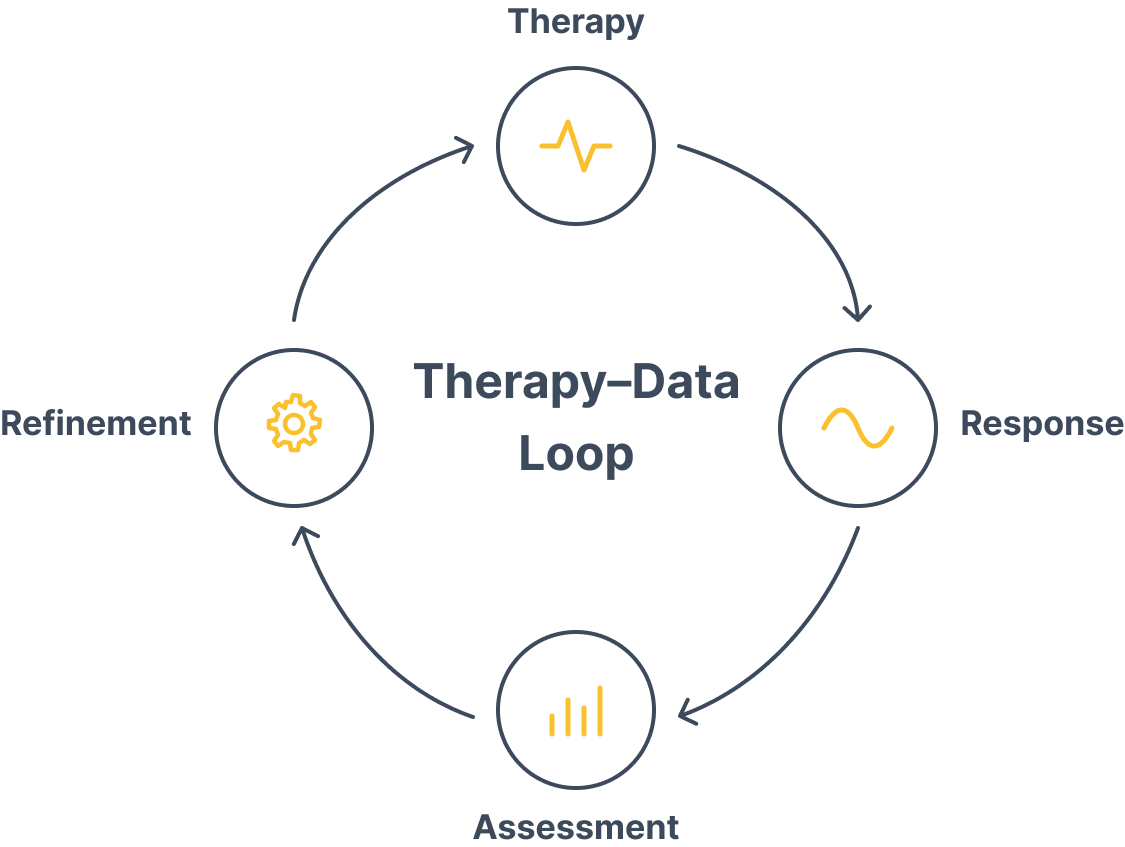
A well-designed therapy–data loop looks like this:
- The system delivers a therapy.
- The system captures the patient’s response.
- The system analyzes the data to assess the effectiveness of the therapy.
- The system refines therapy delivery parameters like scheduling, timing, intensity, or dependence on patient activities.
- The product becomes more personalized and the benefits become more defensible over time.
This is where signal quality matters more than signal quantity. Therapy-response data, captured well, becomes a proprietary asset that compounds with every patient. Captured poorly, it limits everything downstream.
Placement, sampling rate, power management, motion-artifact handling, firmware logic, data compression — these aren’t just engineering choices. They determine whether the data collected can actually feed an algorithm, justify a clinical study, support a regulatory claim, or enable future product expansion. AI and analytics are only as strong as the data foundation they sit on, and AI-ready data acquisition has to be designed into the device — not patched on later.
The right question for next-generation wearable systems isn’t whether the device can collect a signal. It’s whether the system can preserve the clinical meaning of that signal — from the body, to the algorithm, to the therapeutic decision. Biosignal acquisition, ultra-low-power architecture, embedded software, connected device infrastructure, and AI-ready data design all serve that single end.
Neuromodulation as a leading use case
All of the above is particularly applicable to neuromodulation, where research focused on the nervous system as a treatment target is uncovering therapies that rival or outperform drugs for conditions that have resisted treatment for decades.
Drugs tend to act systemically and often require multiple doses before they take effect. And while they may reach the target pathway, they also affect other parts of the body, sometimes producing broad side effects that discourage patient compliance.
Neuromodulation offers a different value proposition:
- more precise targeting of specific nerves, muscles, or anatomical regions,
- adjustable stimulation parameters that can be personalized based on patient response,
- therapy that can be turned on, turned down, or stopped,
- potential reduction in systemic drug exposure,
- compatibility with continuous real-time monitoring of efficacy and patient compliance,
- and a path toward semi-closed-loop or closed-loop therapy.
Two trends have converged to make neuromodulation more practical. First, researchers understand neural pathways better than ever — how specific circuits influence pain, inflammation, movement, sleep, mood, and organ function.
Second, electronics technology has enabled more advanced devices: smaller electronics and electrodes, lower-power components, more capable firmware, improved batteries, and better wireless connectivity.
Together, they create a strategic opening for replacing, reducing, or complementing drugs with more targeted, adjustable, data-driven therapy. It can be electrical, mechanical, thermal, acoustic, magnetic, or optical stimulation designed to influence specific nerves, muscles, or physiological pathways.
A few opportunity areas where this is already taking shape:
Chronic pain. Not just stimulation, but adaptive pain therapy informed by patient-specific data. Systemic pain medications have well-known limits — side effects, tolerance, adherence challenges, and the risk of life-threatening addiction. A wearable neuromodulation system can deliver targeted therapy while continuously monitoring function, activity, pain-related patterns, and response.
Migraine and headache disorders. Wearable neuromodulation may offer an alternative or adjunct to drug therapy, especially where timing, early intervention, patient-specific triggers, and avoidance of systemic side effects all matter.
Neurorehabilitation and functional recovery. Wearables can measure movement quality, guide therapy, improve adherence, and document progress outside the clinic. Some systems can also deliver functional electrical stimulation, biofeedback, or other interventions that help patients retrain movement rather than just track recovery.
Overactive bladder and pelvic health. Targeted stimulation can modulate neural pathways involved in bladder control or pelvic floor function, while sensing and patient-reported data personalize therapy over time.
Neurologic disorders. Wearables can deliver targeted stimulation directly to the brain or peripheral nervous system, using real-time sensing of movement patterns, neural signals, and other biomarkers to guide when and how that stimulation is applied. Applications range from tremor and movement disorders to epilepsy and cognitive rehabilitation.
Respiratory and sleep-related disorders. Therapeutic wearables can use sensing to identify changes in breathing, sleep stage, position, or autonomic state — and deliver stimulation, feedback, or other interventions in response.
The New Wearables Playbook
Knowing therapy is a key playing field for wearables is a great starting point.
But how do you actually build a therapy-delivery wearable with finite capital and a long road to demonstrating clinical efficacy?
In our next post, we dive into the operating side of the problem and the five choices that impact time and risk for therapy-wearable development programs.
MOST READ POSTS
Insights from a decade of milestone-based projects
Transforming biosignals into clinical insights
Why investors say No to medical device startups