

Neurotechnology is gaining momentum
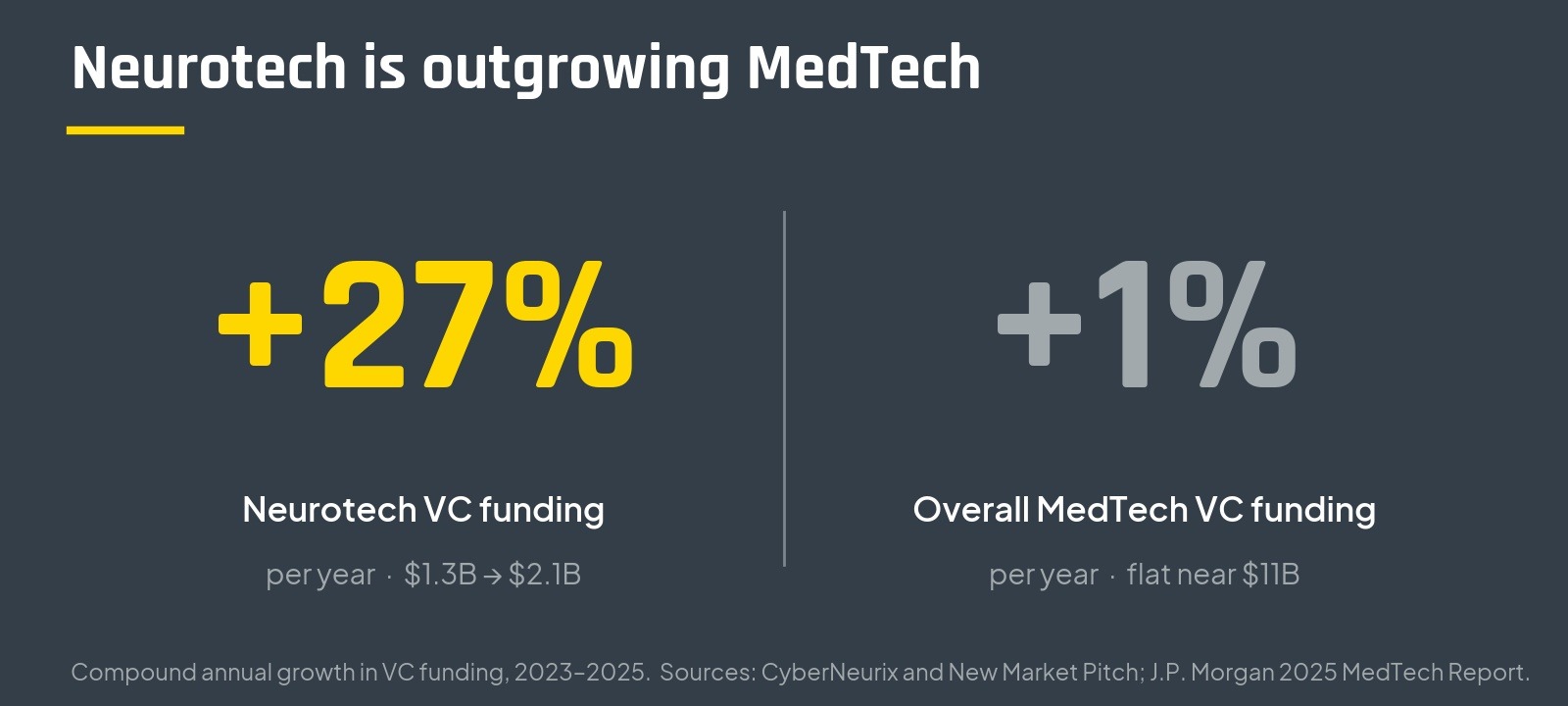
Neurotechnology has been one of the few bright spots in recent MedTech funding, defying the broader industry slowdown.
Neurotech startups raised roughly $2.1 billion in venture capital in 2025, up about 62% from $1.3 billion in 2023. The pace has carried into 2026, with $2.64 billion across 81 disclosed funding events in the first half of the year alone.
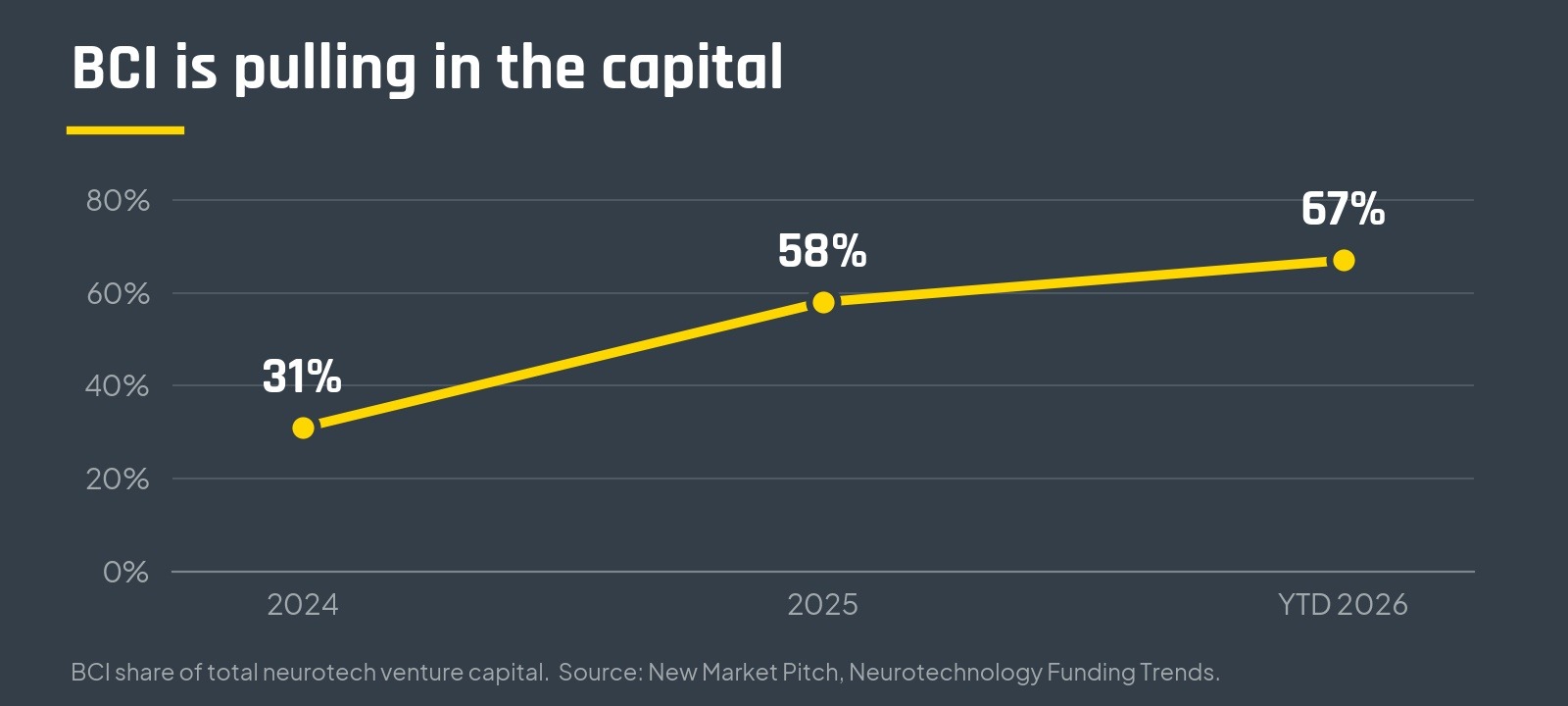
Neurotechnology companies are raising to commercialize implantable neuromodulation, scale FDA-cleared wearable therapies, and build out peripheral nerve stimulation systems. One area that has exhibited outsized growth is brain-computer interfaces (BCI), which captured close to two-thirds of neurotech dollars in the year-to-date period of 2026.
Strategic acquirers are also moving to add neuromodulation to their portfolios. Notable deals over the last 24 months include acquisitions by Boston Scientific (Axonics, Nalu, and Valencia Technologies), Medtronic (SPR Therapeutics), and ResMed (Noctrix).
Each one of these acquisitions targeted devices that deliver therapy, not just data. A therapy-delivering device carries a heavier regulatory burden, but it also generates reimbursable outcomes and a far more defensible position. That is the trade a growing share of investors is willing to make.
What does it mean for neurotech startups?
Momentum works both ways. A hot market draws more founders, which means more competition for a selective pool of capital. Investors have responded by narrowing their focus and screening earlier, looking for proof that a device is buildable, regulatable, and worth scaling.
This article lays out how startups position themselves for funding success:
- They focus on building a competitive moat.
- They accelerate development cycles without compromising their regulatory position.
- They generate data assets that support the required proof points.
- And they ask the right questions upfront to clearly understand the scope of their undertaking.
Focus on your sustainable competitive advantage
A good starting point is acknowledging the premise that most of your device technology is not novel. Founders sometimes hear this as bad news. It is the opposite. It means the parts that look most daunting are the parts a partner has solved many times before.
A pulse generator that listens to bio-signals and delivers a controlled pulse to the human body is well understood. A great many devices already do exactly that. The hardware, the embedded firmware, the power management, the system architecture: these are largely the same from one implant to the next.
What is genuinely unique to your device is narrower, yet more valuable: your stimulation sequence, your physiologic target, and your algorithm. That is the clinical insight no competitor can copy by studying your enclosure. Your moat was never the pulse generator. It is the therapy running on top of it.
This matters because originality in the wrong layer is a misallocation of resources. The teams that build durable neuro devices treat the standard ninety percent as solved and apply their scarce creativity into the ten percent only they can build.
Every hour and dollar spent reinventing a commodity subsystem is an hour and dollar not spent deepening the one thing that differentiates you. Spread your innovation budget across standard components and your advantage gets shallower everywhere at once; concentrate it on the algorithm and the therapy, and the moat gets deeper where it counts.
Accelerate without compromising your regulatory position
No early-stage company has the budget to build a fully implantable system start to finish. Nor should they try. Investors are not funding your roadmap; they are funding your next proof point, and capital efficiency is the difference between reaching that proof point and running out of runway before it.
The disciplined path is to scope to the milestone that unlocks the next round: a proof of concept that validates feasibility, then a version that generates defensible clinical evidence, then a version that optimizes for scale.
Speed always matters. But the goal is not just to move faster. It is to move fast without cutting around the decisions that will define your regulatory durability later.
Some paths offering presumed shortcuts can be too risky. Off-the-shelf “neuromodulation platforms” promise to let you write your own software on top of a ready-made stimulator. They can look like an accelerant, but some carry outdated radios, heavy licensing and royalty obligations, or a breadboard that never actually shrinks into a product. A right-sized custom path, built on reused building blocks that you own, often de-risks more than a licensed platform that comes with hidden shortcomings and strings attached.
Generate defensible data
As neuro devices become more connected and more data-driven, the data itself becomes one of the most valuable things you own. It is the foundation for AI-powered insight, personalized therapy, and the clinical claims you will eventually need to defend. But data is also the gating factor. The future of AI-driven care depends on smarter, more relevant clinical data, not simply more of it.
This is where a costly misconception takes hold. Advances in sensors and the growing capability of consumer wearables have blurred the perceived line between lifestyle data and clinical evidence. In reality, the distinction remains binary. There is no “almost medical.” A product is either a regulated medical device, with validated claims and documented risk controls, or it is not. Many founders underestimate the gap between collecting signals and generating defensible clinical evidence.
Defensibility rests on two things: relevance, meaning the data captures the right outcomes in the right populations, and reliability, meaning the data is accurate, consistent, and traceable. Clean signal acquisition, traceable data pipelines, and design controls that anticipate your future claims are not back-office concerns to bolt on later. They are foundational from day one. Increasingly, they are also what investors screen for before they say yes.
Scope your development effort
Most founders come to a development conversation ready to describe their therapy. Far fewer arrive having worked through the questions that determine timeline, budget, and risk even before the first prototype exists. Asking them early is what separates a solid plan that can be trusted by investors from an expensive discovery process that is prone to risks and setbacks.
How many stimulation channels does our therapy require? Channel count is a direct proxy for hardware complexity, and it ripples through nearly every downstream decision.
Is our device rechargeable, or does it run on a primary cell? This is not a detail to defer. It shapes size, power architecture, the patient experience, and your regulatory story.
Is our target externally accessible, or is it internal? This single question decides whether you are building a wearable or an implantable — and, as we will see, there is very little comfortable middle ground between the two.
Do we need a companion app and cloud connectivity? Almost every serious device does. You should not put something in the human body that you cannot talk to. Founders who assume they can skip this usually reverse course once they think through therapy adjustment, monitoring, and data capture.
How much data do we need to capture? Decisions about data frequency, resolution, processing, and storage requirements must be baked into the design process and balanced with power constraints early in the design cycle.
What is our budget, timeline, and the milestone that unlocks the next round? These business constraints decide which milestones and proof points need to be built into the development plan.
You do not need every answer polished before you start. But asking these questions and closing any gaping holes will put you on a more predictable path to success.
The smart path
The next winning neuro devices will be the ones engineered to deliver clinical utility and defensible validation, built by teams disciplined enough to innovate only where it matters.
Here is what that means for your team:
- Before you build, validate your plan against what investors screen for these days: A defensible regulatory pathway, a clear development strategy, and a milestone plan that conserves capital while gradually removing risks.
- Innovate where your technology is unique: Pour creativity into the algorithm and the therapy; reuse proven, tested building blocks for the rest.
- Treat data as a regulated asset from the first signal: There is no “almost medical” — relevance and reliability should be designed in from the get go, not bolted on as an afterthought.
- Scope to your next funding milestone: Every investment should result in a measurable reduction in uncertainty and get you to a proof point that unlocks the next round.
How can we help?
Nocturnal builds wearable and implantable neuromodulation devices at a fixed cost, so you know upfront what each milestone will take.
Where we typically come in:
- Scoping to your next milestone: We work through the pre-development questions with you and turn the answers into a development plan, budget, and timeline tied to the proof point that unlocks your next round.
- Proven building blocks you own: Ultra-low-power hardware, embedded software, and biosignal acquisition, built around your therapy without platform licensing fees or royalties.
- Connected, AI-ready data: Companion apps, cloud connectivity, and data pipelines designed from the first prototype to support the clinical claims you will need to defend.
- Regulatory and manufacturing readiness: FDA and MDR submission support and low-volume manufacturing, so early design decisions hold up through submission and build.
If you are working through the questions above, talk to our team about scoping your device.
MOST READ POSTS
Insights from a decade of milestone-based projects
Transforming biosignals into clinical insights
Why investors say No to medical device startups